
Recently, an authoritative academic review titled "Histotripsy in tumor therapy: advances in non-thermal mechanical ablation, immune modulation, and clinical translation" authored by researchers from Guangzhou Fuda Cancer Hospital was officially published in Frontiers in Immunology (IF = 7.0), a prestigious international journal in immunology. Professor Lizhi Niu, President of Guangzhou Fuda Cancer Hospital, and Vice President Jiangpeng Cheng serve as co-corresponding authors. Dr. Yangyang Ma, Director of the Central Laboratory, is the first author, with Vice President Xin'an Long as the second author.

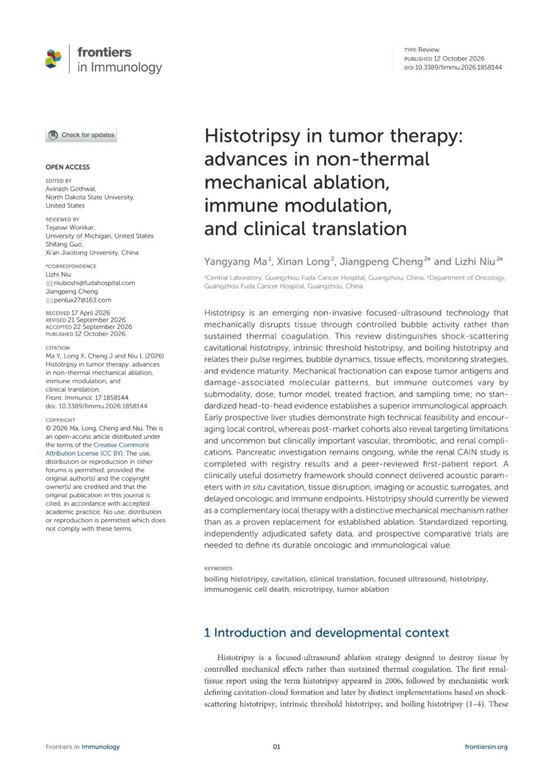
The review systematically synthesizes the physical principles, biological mechanisms, immune microenvironment modulation, and the latest worldwide clinical translation milestones of histotripsy—an emerging non-invasive focused-ultrasound modality—providing critical scientific rationale for the future of non-invasive tumor ablation and combination immunotherapy regimens.
Key Highlights of the Review
· A New Paradigm in Non-Thermal Mechanical Ablation: Unlike conventional thermal ablation (e.g., radiofrequency ablation [RFA], microwave ablation [MWA], and thermal high-intensity focused ultrasound [HIFU]), histotripsy leverages cavitation bubble clouds generated by low-duty-cycle focused ultrasound to mechanically fractionate tumor tissue. It is immune to the "heat-sink effect" and relatively preserves collagen-rich structures such as large blood vessels and bile ducts.
· Elucidating Three Core Technical Subtypes: The review systematically compares shock-scattering histotripsy, intrinsic-threshold histotripsy, and boiling histotripsy across acoustic pulse regimes, bubble dynamics, and specific tissue fractionation patterns.
· Immune Microenvironment Reprogramming & Combination Strategies: Mechanical cell disruption releases substantial tumor antigens and damage-associated molecular patterns (DAMPs), driving dendritic cell (DC) activation and cytotoxic CD8⁺ T-cell tumor infiltration. It demonstrates immense promise in synergy with immune checkpoint blockade (ICB), CD40 agonists, and systemic chemotherapy.
· Clinical Translation Landscape & Safety Profiles: Integrating real-world evidence and pivotal clinical trial data—including U.S. FDA De Novo clearance and the #HOPE4LIVER trials—the authors provide an in-depth summary of clinical efficacy across liver, kidney, and pancreatic malignancies, alongside post-market vigilance regarding potential vascular and renal safety signals.
In-Depth Analysis: How Acoustic Waves Achieve Non-Invasive Tumor Disruption
Thermal ablation modalities like RFA and MWA have long served as primary minimally invasive treatments for solid tumors such as hepatocellular carcinoma. However, their efficacy is frequently constrained by the heat-sink effect near large vessels and the threat of collateral thermal injury. While irreversible electroporation (IRE / Nanoknife) avoids thermal damage, it still necessitates invasive needle insertions. Histotripsy overcomes these limitations through distinct advantages:
1. Physical Mechanism: By directing extracorporeal focused ultrasound into a pinpoint target, high peak negative acoustic pressures generate microsecond bubble clouds. Rapid bubble expansion and violent collapse generate intense mechanical shear stresses, fractionating neoplastic architecture into an acellular, liquid homogenate.
2. Tissue Selectivity: Collagen-dense tissues (such as major vascular walls and bile ducts) possess substantially higher tensile thresholds. Histotripsy completely homogenizes tumor parenchyma while largely sparing surrounding critical structural conduits.
3. Real-Time Acoustic Visualization: The cavitating bubble cloud appears as a dynamic hyperechoic region under real-time B-mode ultrasound, allowing operators to monitor the treatment zone with millimeter precision.
4.
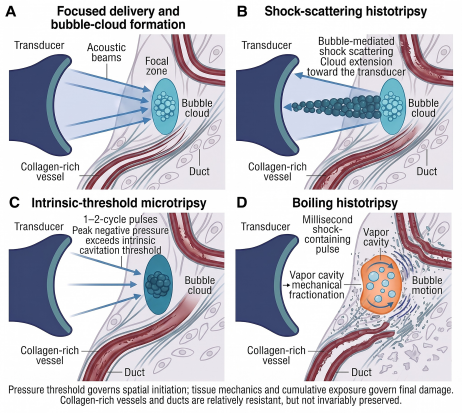
(Figure 1 Caption: Schematic illustration of histotripsy physical mechanisms and tissue selectivity, outlining cavitation dynamics and tissue response across shock-scattering histotripsy, intrinsic-threshold microtripsy, and boiling histotripsy.)
Furthermore, tumor debris generated by mechanical fractionation is captured by dendritic cells and transferred to regional lymph nodes to prime naïve T cells, inducing robust local CD8⁺ cytotoxic T-cell infiltration. Preclinical studies indicate that histotripsy combined with PD-1/PD-L1 inhibitors or CD40 agonists yields potent synergistic antitumor efficacy, occasionally triggering abscopal responses against untreated distant lesions.
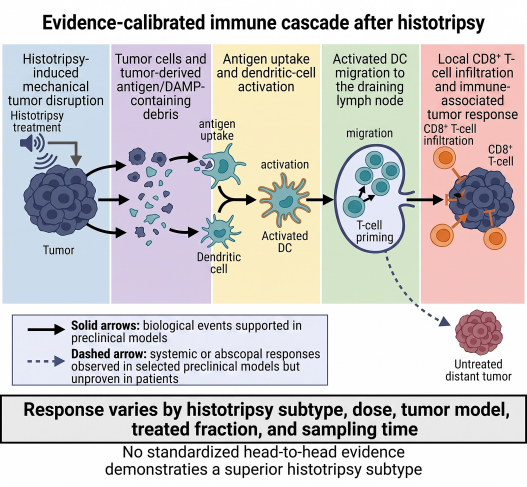
(Figure 2 Caption: Schematic of evidence-calibrated immune cascades following histotripsy, spanning mechanical cytolysis, antigen uptake, DC activation, T-cell priming, and potential abscopal effects.)
Clinical Translation: From Bench to Bedside
From its initial experimental description in 2006 to securing U.S. FDA De Novo marketing clearance in 2023 for hepatic tissue ablation, histotripsy has made rapid clinical strides:
· Liver Malignancies: Pivotal trials demonstrated a 95% technical success rate with high local tumor control (post-hoc evaluation reaching 90.0% at one year). Real-world multi-center data further corroborate its clinical feasibility.
· Expanded Oncologic Indications: The CAIN trial for renal cell tumors has concluded, and clinical evaluation for pancreatic cancer (GANNON trial) is progressing steadily.
· Clinical Vigilance: As an innovative approach, operators must account for targeting learning curves and monitor rare complications observed in real-world cohorts, including vascular injury, portal vein thrombosis, or transient renal events. Continued dosimetry optimization and standardized protocols will be pivotal to unlocking its full therapeutic value.
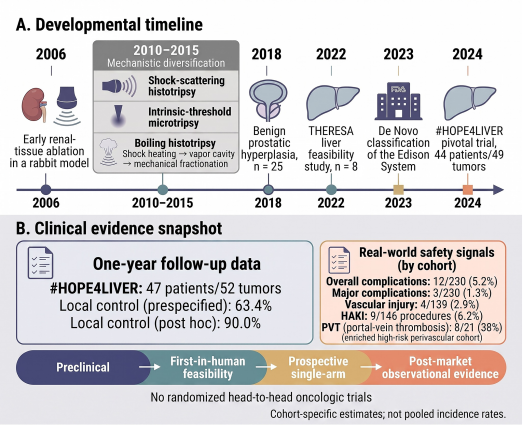
(Figure 3 Caption: 2006–2026 histotripsy developmental milestones and summary of global clinical evidence.)
The publication of this review in Frontiers in Immunology stands as another major testament to the scientific research capabilities of Guangzhou Fuda Cancer Hospital. Guided by the philosophy of "originating from clinical needs, returning to benefit clinical practice," Fuda has published over 500 scientific papers to date. Moving forward, the hospital will continue to pioneer innovations in minimally invasive oncology and immunotherapy to bring safer, cutting-edge therapies to cancer patients worldwide.